
Select a chapter.
 A history
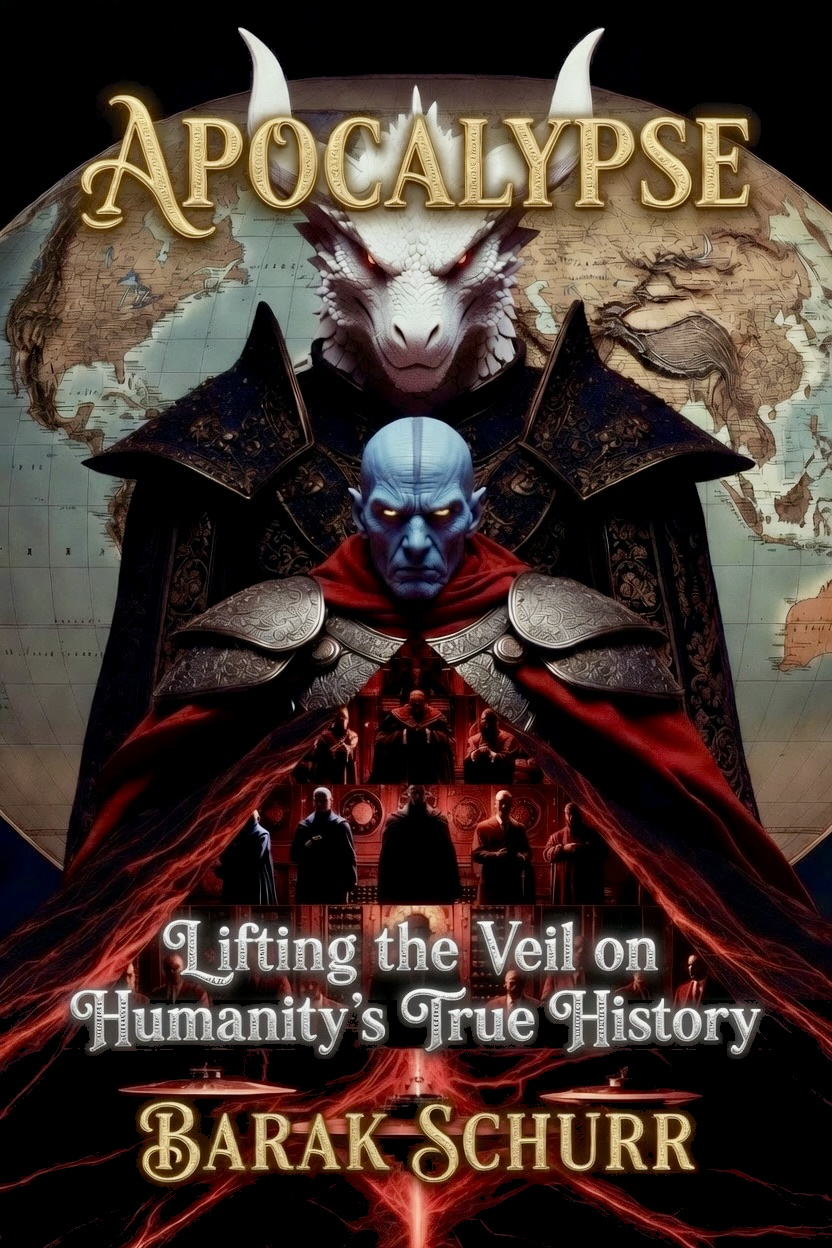
Apocalypse
Lifting the Veil on Humanity’s True History
Barak Schurr
“There has never been a moment in human history when a book like this could be written.”
Not a novel, and not a metaphor. The information is the history that was left out of the textbooks — from the first occupation of this planet to the century we are living in.
The record begins 245 million years ago and ends in the present century. It does not speculate. It documents — in text and over 170 images — what entered this system, what was done to the human population, what was hidden and how, and what is now coming into view. Twelve chapters. One continuous line.
 The word
Apocalypse
Ἀποκάλυψις
The popular imagination turned apocalypse into a synonym for fire. The Greek is stricter. Apokalypsis means the unveiling — the revelation of what was already there, hidden under the account we were given.
The account we were given is this: humanity arrived by chance, developed in isolation, and has no larger significance. That account is the veil.
This book sets down what is underneath it. Not as theory. Not as metaphor. As the record of events — who entered this system and when, what was imposed on the human genome, what civilizations were built and how they were ended, what institutions were constructed to keep the population inside a managed story, and what is now dismantling that management. Twelve chapters. One continuous record, from deep time to the present century.
 Contents
From deep time to the present.
The twelve chapters are periods of a single history. Each one documents what happened, who was present, and what it produced — in the human population, in the civilizations that rose from it, and in the structures still operating today. Select a chapter to read what that period covers.
The first occupation. Two tiers of an entering force, and what they found already here.
A second arrival. A division of authority. A decision made about the human population.
Communities move out of the operational zones carrying something they do not know they are carrying.
A system falls. Survivors enter this one. What they brought with them did not leave.
A civilization is established on the Atlantic continent. Its foundations are older than it knows.
The undermining came from inside. The sinking was not a natural event alone.
After the flood: what survived, what was rebuilt, and what the difference between the two reveals.
Occupation moves out of the open. The structures built to replace it are the ones people are taught to defend.
Suppressed research. Managed war. The occupation continuing through the modern state.
The plan was written down. The counter-effort was already in place before the plan had a public name.
The word does not mean destruction. This chapter treats the uncovering as an event.
A free species still has to claim its freedom. It is not handed over.
 The edition
The book, as printed.
- Author
- Barak Schurr
- Form
- Full-length book
- Span
- Deep time to now
- Chapters
- Twelve, plus prologue
- Editions
- Hardcover · eBook
- Illustrations
- Over 170 images
The book does not argue that hidden history exists. It sets it down. The chapters move in sequence from the first occupation of this planet to the present decade, and each one names what happened, who was responsible, and what it left behind. The prologue establishes why this moment — not fifty years ago, not fifty years from now — is when this record becomes possible to publish.
Entering print. Available in hardcover and eBook. The book is fully illustrated — over 170 images documenting the history across all twelve chapters.
Everything you were taught about where humanity came from, how civilisations rose and fell, and who has been directing the story — was a version. Not the whole record.
The whole record is older, larger, and more deliberate than the version allows for. It has been recoverable for some time. What has changed is that it can now be set down in full, in sequence, without gaps — from the first entry into this system to the decisions being made in the present decade.
That is what this book does. Not as argument. Not as speculation. As the history that was kept out of the room — returned to the people it belongs to.
The edition